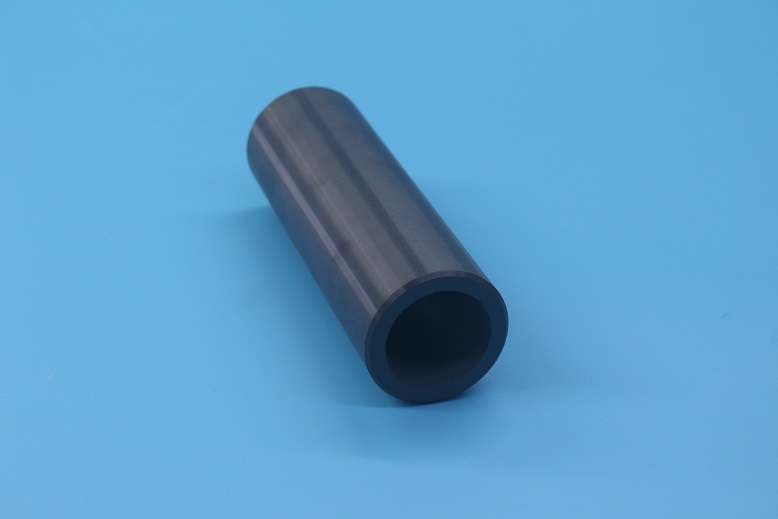
What is Silicon Carbide Ceramic?
Silicon carbide ceramics are high-performance inorganic non-metallic materials made primarily of silicon carbide (SiC) through powder synthesis, molding, high-temperature sintering, and subsequent precision machining. Due to its advantages such as low coefficient of thermal expansion, high thermal conductivity, high hardness, and good thermal and chemical stability, silicon carbide (SiC) ceramics occupy an important place in high-temperature structural ceramics and are one of the most widely used materials in structural ceramics. According to industry data and Mingrui's past orders, silicon carbide has been widely used in aerospace, nuclear energy, military, and semiconductor fields.
Due to the extremely strong covalent bonds and very low diffusion coefficient of SiC, it is quite difficult to complete the densification of
silicon carbide ceramic parts. Therefore, various sintering techniques for SiC ceramics have been developed, including reaction sintering, pressureless solid-state sintering, pressureless liquid-phase sintering, hot pressing sintering, and recrystallization sintering. Each of these different sintering techniques has unique advantages, and the fabrication of SiC ceramics differs in microstructure, properties, and applications. Can you distinguish between these different types of silicon carbide ceramics?
Comparison of Different Types of Silicon Carbide Ceramics
01 Pressureless Sintering of SiC Ceramics (S-SiC)
Pressureless sintering is considered the most promising sintering method for SiC. This method is adaptable to various forming processes, has lower production costs, and is not limited by shape or size, making it the most common and easiest sintering method for mass production.
Pressureless sintering involves adding boron and carbon to β-SiC containing trace amounts of oxygen, and sintering at around 2000℃ in an inert atmosphere to obtain silicon carbide sintered bodies with 98% theoretical density. This method generally has two approaches: solid-state sintering and liquid-state sintering. Pressureless solid-state sintered silicon carbide exhibits high density and purity, and in particular, it possesses unique high thermal conductivity and excellent high-temperature strength, making it easy to process into large-sized, complex-shaped ceramic devices.
Pressureless sintered silicon carbide products: (a)
SSiC ceramic seal rings; (b) SiC ceramic bearings; (c) SiC bulletproof plates.
In terms of applications, SSiC is simple to operate and moderately cost-effective, suitable for mass production of ceramic parts of various shapes. It is widely used in wear-resistant and corrosion-resistant sealing rings, sliding bearings, etc. Furthermore, pressureless sintered silicon carbide ceramics are widely used in bulletproof armor due to their high hardness, low specific gravity, good ballistic performance, ability to absorb more energy after breakage, and low price. For example, vehicle and ship protection, civilian safes, armored truck protection. As a bulletproof armor material, it exhibits excellent resistance to multiple impacts, with an overall protective effect superior to ordinary silicon carbide ceramics. When used in lightweight cylindrical ceramic protective armor, its fracture point can reach over 65 tons, demonstrating a significantly better protective effect than cylindrical ceramic protective armor using ordinary silicon carbide ceramics.
Mingrui Ceramic mainly employs pressureless sintering technology for SiC. This mature technique not only helps customers control costs but also ensures product quality and density. Its advantages include compatibility with various forming methods, allowing flexibility in product shape and size. With the appropriate additives, it can achieve high strength and toughness.
02 Reaction-Sintered SiC Ceramics (RB-SiC)
Reaction-sintered SiC is a highly attractive structural ceramic with excellent mechanical properties such as high strength, corrosion resistance, and oxidation resistance. It also boasts advantages such as low sintering temperature, low sintering cost, and near-net-shape forming.
The reaction-sintering process is simple. A green body is prepared by mixing a carbon source and SiC powder. Then, under high-temperature capillary force, molten silicon is infiltrated into the porous green body, reacting with the carbon source inside to form a β-SiC phase, which simultaneously bonds tightly with the original α-SiC. The remaining pores are filled with molten silicon, thus achieving densification of the ceramic material. With minimal dimensional shrinkage during sintering and near-net-shape forming, complex-shaped samples can be prepared as required. Therefore, it is widely used in the industrial production of various ceramic products. However, the drawbacks are that the initial preparation process of the green body is too complicated, and the by-products produced are polluting. In addition, the service temperature range of RB-SiC ceramic materials is affected by the free Si content in the material. When the temperature is above 1400°C, the strength of the material will decrease rapidly as the free Si melts.
Applications of Reaction-Sintered SiC Ceramics:
Typical applications of reaction-sintered silicon carbide ceramics include high-temperature kiln furniture materials, radiant tubes, heat exchangers, and desulfurization nozzles. Meanwhile, due to its low coefficient of thermal expansion, high elastic modulus, and near-net-shape sintering characteristics, RB-SiC has become an ideal material for space mirrors. Furthermore, with the increase in wafer size and heat treatment temperature, reaction-bonded silicon carbide is gradually replacing quartz glass. High-purity silicon carbide components containing a partial silicon phase can be fabricated using high-purity silicon carbide powder and high-purity silicon, and are widely used in support fixtures for electron tube and semiconductor wafer manufacturing equipment.
03 Hot-Pressed Sintered SiC Ceramics (HP-SiC)
Hot-press sintering is a sintering process that simultaneously sintersects and shapes materials under high temperature and high pressure. Dry silicon carbide powder is filled into a high-strength graphite mold, and a certain pressure is maintained during heating, ultimately achieving simultaneous shaping and sintering.
Because heating and pressurization occur simultaneously in hot-press sintering, the powder is in a thermoplastic state, which facilitates particle contact diffusion and mass transfer processes. This allows for the production of silicon carbide ceramic products with fine grains, high relative density, and excellent mechanical properties at relatively low sintering temperatures and shorter sintering times. Furthermore, hot-pressed SiC ceramics can achieve a fully dense, near-pure sintered state.
In terms of applications, HP-SiC was initially used by US helicopter crews as body armor during the Vietnam War in the 1960s. However, with technological advancements, the high-performance armor ceramic market for HP-SiC has been replaced by hot-pressed boron carbide, which has become the top-tier product in the armor market, offering high added value. For this type of ceramic material, the control of composition, purity, and densification are far more important than economic cost considerations. In addition, HP-SiC is also used in wear-resistant and nuclear industry applications.
04. Recrystallized SiC Ceramics (R-SiC)
Recrystallization sintering technology has attracted widespread attention due to its elimination of the need for sintering aids. Recrystallization sintering is the most commonly used method for preparing ultra-high purity, large-scale SiC ceramic devices. The preparation process of recrystallized sintered SiC ceramics (R-SiC) is as follows: Coarse and fine SiC powders of different particle sizes are mixed in a certain proportion and prepared into green blanks through processes such as slip casting, molding, and extrusion; then, the green blanks are sintered at a high temperature of 2200~2450 ℃ under an inert atmosphere; finally, the fine particles gradually evaporate into a gas phase and condense at the contact points with the coarse particles, forming R-SiC ceramics.
R-SiC forms at high temperatures and has a hardness only below that of diamond. It retains many excellent properties of SiC, such as strong high-temperature strength, strong corrosion resistance, excellent oxidation resistance, and good thermal shock resistance. Therefore, it is an ideal candidate material for high-temperature kiln furniture, heat exchangers, or combustion nozzles. In the aerospace and military fields, R-SiC is used to manufacture structural components of aerospace vehicles, such as engines, tail fins, and fuselages. Due to its superior mechanical properties, corrosion resistance, and impact resistance, it can greatly improve the performance and service life of aerospace vehicles.
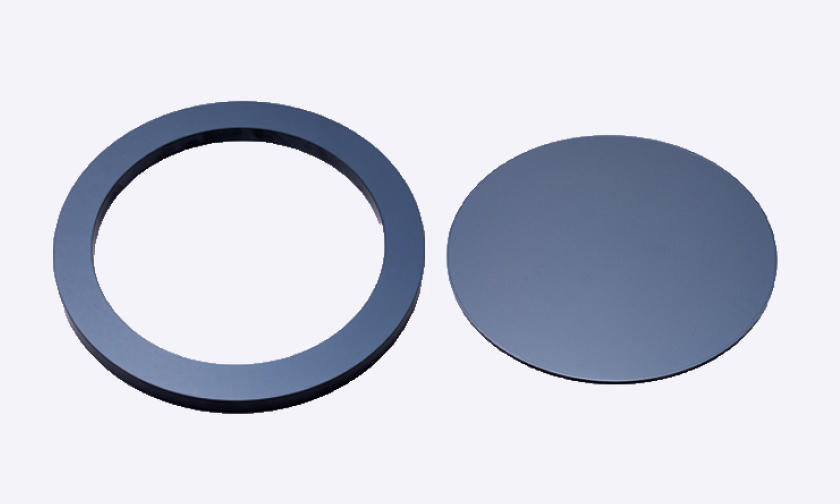
SiSiC products Source: kyocera
05. Silicated SiC Ceramics (SiSiC)
Compared to sintering processes such as hot pressing and pressureless methods, silica infiltration is best suited for industrial production of SiC. Its advantages include shorter sintering time, lower sintering temperature, achieving full density, and no deformation during sintering. SiSiC consists of a SiC matrix and infiltrated Si phases. Different silica infiltration processes result in significantly different properties and applications.
Liquid Infiltration: Silicon carbide powder and carbon powder are mixed and pressed into shape, or porous carbon raw materials are used for additive manufacturing, casting, or extrusion molding. Molten silicon infiltrates into the green body. During sintering, silicon reacts with carbon to generate more silicon carbide, simultaneously filling pores and increasing the material's density and strength. Therefore, this is also called reactive sintered silicon carbide.
Gas Infiltration: Silicon vapor or a reactive gas containing both silicon and carbon sources is infiltrated into carbon materials or silicon carbide green bodies, followed by high-temperature reaction or deposition. While this method is more expensive, it offers better ceramic density and uniformity of free silicon.
In applications, due to silicon infiltration, SiSiC ceramics have low porosity, ensuring excellent airtightness. Silicon doping also increases the concentration of free carriers (electrons or holes) in the material, resulting in lower electrical resistance than silicon carbide, which helps eliminate static electricity in parts. Its manufacturing process and properties are advantageous for producing large, complex-shaped parts or hollow structures, leading to wider applications in semiconductor processing equipment. Secondly, it possesses a high elastic modulus, a characteristic that allows it to withstand heavy loads without significant shape changes under the microgravity environment and mechanical stress of space, ensuring the accuracy and structural safety of space equipment. Furthermore, its excellent airtightness and waterproof performance, combined with high strength, superior rigidity and reliability, and extremely low weight, collectively solidify SiSiC's position as the preferred high-performance material in the aerospace field.
Silicon Carbide FAQs:
1.
Introduction to silicon carbide ceramic material
2. What are the advantages and applications of silicon carbide ceramic bushings?
3. Properties and applications of pressureless sintered silicon carbide ceramics
4. Important applications of silicon carbide ceramics in semiconductors



 Moble: +86 18122974730
 Phone: +86 746 3386888
 Email: admin@cerampart.com
 Mobile version