The classifier wheel is the core component of air jet mills and classifiers, specifically designed for sorting powder particles by size. As the material moves with the rising airflow into the classification zone, coarse and fine particles are separated; fine particles that meet the particle size requirements pass through the classification wheel into the next assembly for collection, while coarse particles fall back into the grinding zone for further grinding.
Types of Classifier Wheels
Based on the material used, classifier wheels are categorized into ceramic classifier wheels, metal classifier wheels, and composite classifier wheels. Here, we will focus on ceramic classifier wheels.
Alumina ceramic classifier wheels are commonly used in various applications. Alumina ceramic is a highly wear-resistant precision ceramic material characterized by extremely high hardness and wear resistance, strong corrosion resistance, high-temperature resistance, and biocompatibility. Therefore, using alumina ceramic to manufacture classifier wheels is an excellent choice.
Composition and Structure of Ceramic Classifier Wheels
The ceramic classifier wheel comprises a front flange, a rear flange, a plurality of blades, and a gas-sealing disc. The blades are respectively fixedly connected to the front flange and the rear flange. An annular groove is provided on the gas-sealing disc, and the rear end portions of the blades are inserted into the annular groove. A feed gap is formed between adjacent blades, and the inner sides of the plurality of blades define a cavity. The rear end portion of each blade is provided with a radially enlarged blade tail portion. The rotational linear velocity of the blade tail portion is higher than that of the blade portion on its front side. Therefore, the airflow generated by the rotation of the blade tail portions can prevent the powder from entering beyond the outer side of the blade tail portions. As a result, the powder must be selectively guided by the rotating blades and enter the discharge pipe through the feed gaps.



 Moble: +86 18122974730
 Phone: +86 746 3386888
 Email: admin@cerampart.com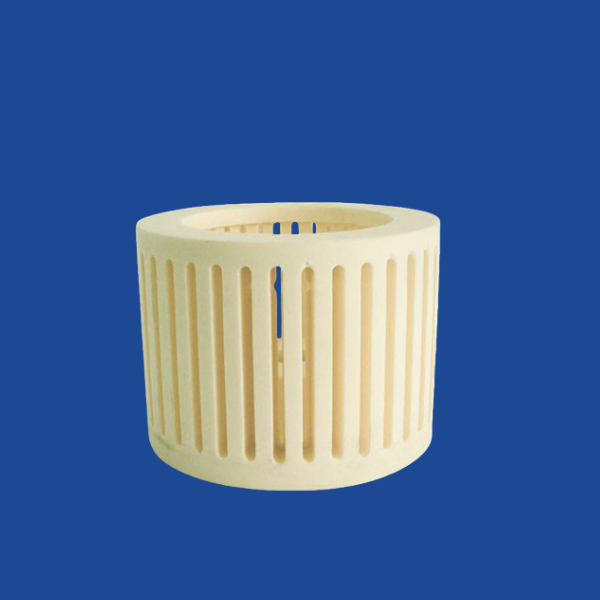

 Mobile version